

Smart Office Market Valued at USD 62.75 Billion in 2025, Forecast to Hit USD 203.78 Billion by 2035
Smart Office Market
Smart Office Market Size, Share and Research Report: By Technology (Internet of Things, Artificial Intelligence, Cloud Computing, Big Data, Automation),
Smart Office Market is expanding rapidly as organizations adopt IoT-enabled technologies, AI, and automation to enhance workplace efficiency, collaboration, and employee productivity.”
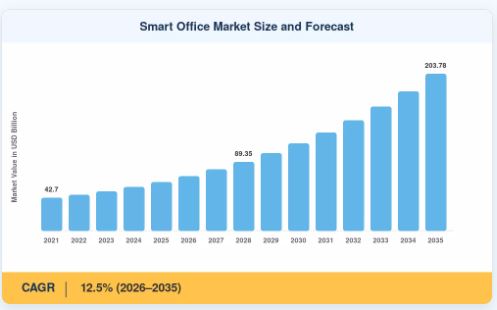
TOKYO, TOKYO, JAPAN, August 3, 2026 /EINPresswire.com/ -- The Global Smart Office market was estimated at USD 62.75 billion in 2025 and is projected to grow from USD 70.60 billion in 2026 to USD 203.78 billion by 2035, registering a CAGR of 12.5 % during the forecast period. The market is currently experiencing a transformative phase, driven by advancements in smart office systems and a growing emphasis on sustainability, as organizations increasingly adopt smart office services to enhance operational efficiency, improve employee productivity, and create a more engaging work environment. This shift is characterized by the integration of Internet of Things devices, artificial intelligence, and data analytics, which collectively facilitate real-time monitoring and management of office resources.— Market Research Future (MRFR)
The market is also witnessing a notable shift toward hybrid work models, where flexibility and adaptability are paramount, with companies investing in smart office systems that support remote collaboration and seamless communication among teams regardless of physical location. This trend not only enhances employee satisfaction but also contributes to cost savings and resource optimization.
The market for smart building technologies is projected to reach USD 100 billion by 2026, underscoring strong demand for integrated solutions, while the broader market for smart infrastructure is expected to grow at a compound annual growth rate of over 20% in the coming years. North America is the largest market for smart offices, holding approximately 40% of global share, followed by Europe at approximately 30% and Asia-Pacific at around 25%, while the Middle East and Africa region accounts for approximately 5% of the global share. As the market evolves, the focus will remain on creating intelligent environments that foster innovation and collaboration, ultimately redefining the future of work.
Get Full PDF Sample Copy of Report: (Including Full TOC, List of Tables & Figures, Chart) @
https://www.marketresearchfuture.com/sample_request/6575
➤ How Significant Is the Smart Office Market's Growth?
The smart office market's trajectory from USD 70.60 billion in 2026 to a projected USD 203.78 billion by 2035 represents nearly a two-and-a-half-fold expansion over the forecast decade, reflecting the structural shift from traditional office infrastructure toward intelligent, data-driven workplace environments as hybrid work becomes a permanent fixture of corporate operations. The market's 12.5 % CAGR is anchored in the convergence of automation, sustainability mandates, and evolving employee expectations that are together redefining what a modern office must deliver.
The Internet of Things has emerged as the largest technology segment, projected to reach USD 42.0 billion by 2035, as interconnected devices facilitate real-time data sharing and improved operational efficiency, while Artificial Intelligence is the fastest-growing technology segment, bringing predictive analytics and machine learning to the forefront of smart office applications. Within smart office solutions, Smart Lighting holds the largest share, favored for its adaptability and cost-saving potential, while Collaboration Tools and Room Scheduling Systems are the fastest-growing solutions, projected to reach USD 41.0 billion and USD 57.94 billion respectively by 2035 as hybrid work models accelerate demand.
Corporate Offices represent the largest end-user segment at a projected USD 55.0 billion by 2035, while SMEs are the fastest-growing end-user segment, and Cloud-Based deployment leads by adoption while On-Premises deployment remains significant among security-conscious organizations, projected to reach USD 65.0 billion by 2035.
➤ What Does the Future Hold for the Smart Office Market?
Integration of advanced technologies is a primary driver of the smart office market, as companies increasingly adopt smart lighting, climate control, and security systems that can be managed remotely. The market for smart building technologies is projected to reach USD 100 billion by 2026, reflecting strong demand for integrated solutions that streamline processes while reducing energy consumption in alignment with sustainability goals.
The rise of remote work and hybrid models is reshaping the market as organizations adapt to flexible work arrangements, creating growing need for technologies that facilitate collaboration and communication among dispersed teams virtual meeting platforms and collaborative software are becoming essential tools for maintaining productivity, and companies investing in smart office technologies report enhanced employee engagement critical for talent retention.
Increased investment in smart infrastructure is a further driver, with the market for smart infrastructure expected to grow at a compound annual growth rate of over 20% in the coming years as governments and private sectors collaborate to promote smart-city initiatives that often include smart office components. A focus on sustainability and energy efficiency continues to underpin demand: energy-efficient buildings can reduce energy consumption by up to 30%, a compelling incentive as regulatory frameworks evolve to support sustainable practices.
Growing demand for data-driven decision making is also propelling adoption, as organizations leverage data analytics to gain insights into employee behavior, space utilization, and operational efficiency, with businesses utilizing data analytics able to improve operational efficiency by up to 25%. New opportunities are emerging in the integration of AI-driven analytics for workspace optimization, development of IoT-enabled energy management systems, and expansion of remote collaboration tools for hybrid work environments developments that are expected to sustain robust growth and innovation in the smart office market through 2035.
Get access to the full description of the report @
https://www.marketresearchfuture.com/reports/smart-office-market-6575
➤ Who Are the Key Players in the Smart Office Market?
The smart office market is moderately fragmented, featuring a mix of established players and emerging startups that together offer a diverse range of solutions, though the influence of key players remains substantial as they set benchmarks for innovation and operational excellence. MRFR identifies the following key participants:
★ Cisco Systems (US) - focuses on integrating advanced networking solutions with IoT capabilities, facilitating seamless communication and collaboration in smart office environments, and announced a strategic partnership with a leading AI firm to integrate AI-driven analytics into its existing platforms.
★ Johnson Controls (US) - emphasizes sustainability and energy efficiency, leveraging its expertise in building management systems to create eco-friendly office spaces, and unveiled a new suite of smart building technologies designed to improve indoor air quality and energy efficiency.
★ Schneider Electric (FR) - is heavily invested in digital transformation, promoting its EcoStruxure platform to optimize energy management and automation in smart buildings, and expanded the platform to include enhanced cybersecurity features.
★ Honeywell International (US) - launched a new smart office platform designed to optimize energy use, improve employee comfort, and support hybrid work models through integrated IoT and AI technologies.
★ Siemens (DE) - announced a strategic partnership with Cisco to co-develop integrated smart office solutions combining building automation, security, and advanced connectivity for enterprise clients.
★ Philips Lighting / Signify (NL) - introduced the third generation of its Interact Office platform, offering advanced lighting controls and real-time occupancy analytics to improve office efficiency and sustainability.
★ IBM (US) - contributes innovative solutions tailored to regional needs, particularly across the Asia-Pacific smart office landscape alongside fellow technology leaders.
★ Microsoft (US) - partnered with Enlighted, a Siemens company, to integrate smart office sensor data with Azure, enabling advanced analytics and workplace insights for enterprise customers.
★ Google (US) - enhances the North American market's competitive dynamics, fostering a culture of continuous improvement and technological advancement in workplace technology.
Strategic competition in the smart office market is increasingly defined by depth of AI and IoT integration, sustainability and energy-management credentials, cybersecurity capability, and the pace at which vendors can shift competitive differentiation from price toward technological innovation and supply-chain reliability.
➤ What Are the Emerging Trends in the Smart Office Market?
Several transformational trends are redefining the smart office market's evolution through 2035:
Integration of IoT Devices: The market is increasingly characterized by IoT devices that enable real-time data collection and analysis, allowing organizations to monitor energy consumption, occupancy levels, and equipment usage while supporting sustainability initiatives.
Emphasis on Employee Well-being: Companies are recognizing the importance of creating environments that promote health and productivity through smart lighting, air quality monitoring, and ergonomic furniture aimed at enhancing the overall workplace experience.
Adoption of AI-Powered Solutions: AI-powered smart office systems are becoming increasingly prevalent, facilitating automation of routine tasks, enhancing decision-making, and providing personalized experiences that streamline operations and drive productivity.
Hybrid Deployment Models: Hybrid deployment, which combines elements of both cloud and on-premises setups, is gaining traction as companies seek to balance data control with the scalability benefits of cloud technology.
AI-Driven Workspace Optimization: New opportunities are emerging in the integration of AI-driven analytics for workspace optimization and the development of IoT-enabled energy management systems that support more precise resource allocation.
Expansion of Remote Collaboration Tools: The expansion of remote collaboration tools for hybrid work environments continues to accelerate as organizations invest in technologies that maintain productivity and engagement across dispersed teams.
Buy Full Research Report:
https://www.marketresearchfuture.com/checkout?currency=one_user-USD&report_id=6575
➤ How Is the Smart Office Market Segmented?
The smart office market report provides a comprehensive segmentation framework:
By Technology: Internet of Things (largest, USD 42.0 Billion by 2035), Artificial Intelligence (fastest-growing, USD 35.0 Billion by 2035), Cloud Computing, Big Data, Automation (USD 39.69 Billion by 2035)
By Smart Office Solutions: Smart Lighting (largest), Smart Thermostats, Smart Security Systems, Collaboration Tools (USD 41.0 Billion by 2035), Room Scheduling Systems (fastest-growing, USD 57.94 Billion by 2035)
By End User: Corporate Offices (largest, USD 55.0 Billion by 2035), SMEs (fastest-growing), Educational Institutions, Government Offices, Healthcare Facilities (USD 31.69 Billion by 2035)
By Deployment Type: On-Premises (USD 65.0 Billion by 2035), Cloud-Based (largest, USD 50.0 Billion by 2035), Hybrid (fastest-growing)
By Region: North America (~40% share), Europe (~30% share), Asia-Pacific (~25% share), Middle East & Africa (~5% share)
➤ What Are the Regional Insights from the Smart Office Market?
North America is the largest market for smart offices, holding approximately 40% of the global market share, with growth driven by automation, energy efficiency, and investments in smart office systems. Regulatory support for green building initiatives and smart technologies further catalyzes market expansion, and the United States and Canada are the primary contributors, with significant investments in smart infrastructure and IoT technologies. The competitive landscape in North America is robust, featuring key players like Cisco Systems, Johnson Controls, and Honeywell International, while the presence of tech giants such as Microsoft and Google enhances the region's market dynamics.
Europe holds approximately 30% of the global share, with the region's emphasis on sustainability and energy efficiency driving demand for smart solutions. Regulatory frameworks such as the EU's Green Deal promote the adoption of smart technologies in office spaces, enhancing energy management and reducing carbon footprints, and Germany, France, and the UK are the leading countries in this market, supported by favorable policies and investments. The competitive landscape features companies like Schneider Electric and Siemens innovating to meet growing demand for integrated systems that enhance user experience and operational efficiency, with numerous startups contributing to a dynamic market environment.
Asia-Pacific holds around 25% of the global market share and is rapidly emerging as a significant player, with growth fueled by rapid urbanization, increasing disposable incomes, and a growing focus on workplace efficiency. China and India are leading this trend, supported by government initiatives promoting smart-city developments and technological advancements in IoT and AI, with China representing the largest market in the region through substantial investments in smart infrastructure and office automation. The competitive landscape includes major players like IBM and Philips Lighting, alongside numerous tech startups that enhance the market's dynamism.
The Middle East and Africa region is gradually emerging in the smart office market, accounting for approximately 5% of the global share, with growth driven by increasing urbanization, a shift toward digital transformation, and government initiatives aimed at enhancing workplace efficiency. The UAE and South Africa are at the forefront, with investments in smart technologies and infrastructure development supporting market growth, and the competitive landscape is evolving with key players like Honeywell and Siemens establishing a presence focused on integrating smart technologies to improve energy management and operational efficiency.
➤➤➤ Regional & Country-Level Reports by Market Research Future:
US Smart Office Market -
https://www.marketresearchfuture.com/reports/us-smart-office-market-16355
➤➤➤ Related Reports by Market Research Future:
Audio Production Equipment Market
https://www.marketresearchfuture.com/reports/audio-production-equipment-market-34330
B2C Legal Service Market
https://www.marketresearchfuture.com/reports/b2c-legal-service-market-42525
Bancassurance Market
https://www.marketresearchfuture.com/reports/bancassurance-market-23854
Building Twin Market
https://www.marketresearchfuture.com/reports/building-twin-market-29038
Car Insurance Aggregators Market
https://www.marketresearchfuture.com/reports/car-insurance-aggregators-market-23929
Chemical Detection Market
https://www.marketresearchfuture.com/reports/chemical-detection-market-29008
Closed Circuit Television Cctv Camera Market
https://www.marketresearchfuture.com/reports/closed-circuit-television-cctv-camera-market-35844
Commercial Payment Cards Market
https://www.marketresearchfuture.com/reports/commercial-payment-cards-market-23869
Consumer Durable Loans Market
https://www.marketresearchfuture.com/reports/consumer-durable-loans-market-40608
Credit Card Payment Market
https://www.marketresearchfuture.com/reports/credit-card-payment-market-23915
Sagar Kadam
Market Research Future
+ + +1 628-258-0071
email us here
Legal Disclaimer:
EIN Presswire provides this news content "as is" without warranty of any kind. We do not accept any responsibility or liability for the accuracy, content, images, videos, licenses, completeness, legality, or reliability of the information contained in this article. If you have any complaints or copyright issues related to this article, kindly contact the author above.
