

Why Airport Non-Aeronautical Revenue Is Racing to USD 151.39 Billion by 2035?
Airport Non-Aeronautical Revenue Market
North America leads a global airport non-aeronautical revenue market and growing at a CAGR of 8.39% yearly.
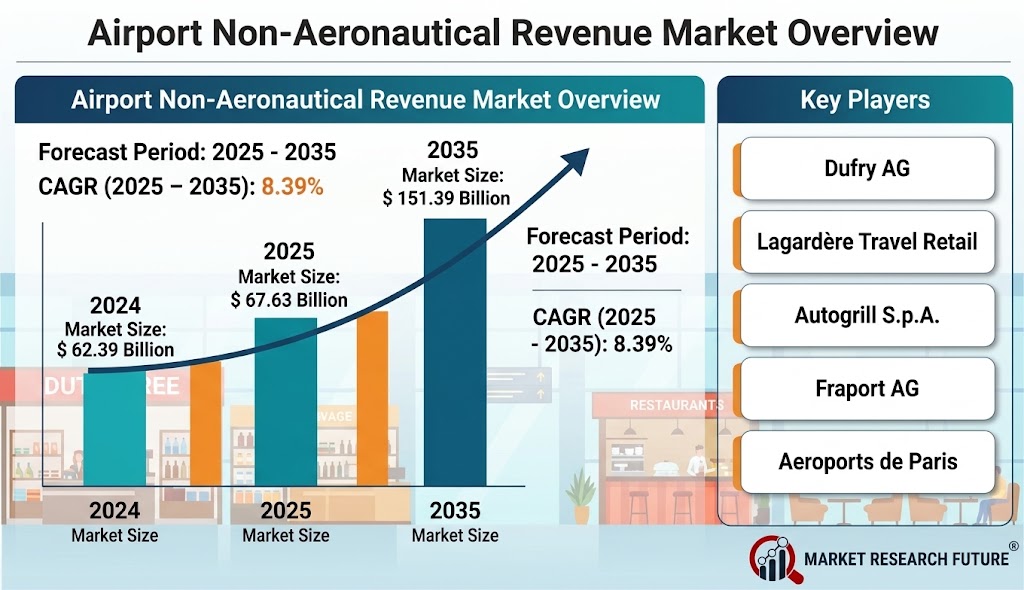
NEW YORK, NY, UNITED STATES, August 27, 2026 /EINPresswire.com/ -- Global airports are increasingly leaning on shops, restaurants, parking, advertising, and lounges to power their bottom lines, and new industry analysis shows that shift is accelerating fast. The global airport non-aeronautical revenue market, valued at an estimated US$ 62.39 billion in 2024, is projected to climb to roughly US$ 67.63 billion in 2025 and reach approximately US$ 151.39 billion by 2035, reflecting a compound annual growth rate (CAGR) of close to 8.39% across the 2025–2035 forecast window. The findings point to a sector that is no longer a secondary consideration for airport operators but a central pillar of long-term financial strategy.Non-aeronautical revenue — income airports generate from sources other than landing fees, gate charges, and other flight-related operations — has become one of the fastest-growing corners of the broader aviation economy. As passenger volumes rebound and travelers spend more time and money inside terminals, airport authorities and their commercial partners are racing to capture a bigger share of that spending through retail expansion, richer dining concepts, smarter parking systems, and digitally enabled advertising.
A Market Built on Diversified Income Streams:
The scale of this transformation is significant. Industry estimates suggest the market could nearly guarter its 2024 value over the coming decade, underscoring just how central commercial revenue has become to airport business models worldwide. Analysts tracking the space note that the acceleration is being driven by a combination of structural and behavioral shifts: rising global air travel, a growing appetite among passengers for premium in-terminal experiences, and airport operators actively rethinking how terminal space is monetized.
Request for Free Sample of Report: https://www.marketresearchfuture.com/sample_request/29551
Historically, airports leaned heavily on aeronautical charges — fees tied directly to aircraft operations — to fund infrastructure and daily operations. That model has proven vulnerable to volatility, from fluctuating fuel costs to shifts in airline capacity. In response, airport operators across nearly every region have doubled down on commercial revenue streams that are less tied to flight schedules and more tied to the volume and behavior of people moving through the terminal. The result is a market defined by diversification: retail concessions sit alongside food and beverage outlets, ground transportation and parking services, advertising and sponsorship placements, and an expanding category of ancillary offerings such as lounges, wellness facilities, and entertainment zones.
Key Trends Shaping the Industry:
Three broad trends stand out in current market analysis.
Diversification of revenue streams remains the dominant theme. Airports are no longer content with a narrow retail mix; they are actively curating broader assortments of shops, dining concepts, and services designed to extend passenger dwell time and encourage spending. This has translated into airports behaving increasingly like mixed-use commercial destinations rather than pure transit infrastructure.
Technology integration is reshaping how airports engage travelers and convert foot traffic into revenue. Mobile applications, digital way-finding, contactless payment systems, and self-service kiosks are becoming standard fixtures, allowing operators to personalize offers, streamline transactions, and gather data on passenger preferences that can be used to fine-tune commercial strategy in real time.
Sustainability initiatives are emerging as a third pillar. Airports are pursuing environmentally conscious retail and dining partnerships, reducing single-use packaging, and pursuing green certifications for terminal concessions — moves that appeal to increasingly eco-aware travelers while opening the door to new categories of sponsorship and brand partnership tied to sustainability messaging.
What's Driving Growth?
Several forces are converging to push the market forward. Passenger traffic growth remains the foundational driver — as more people fly, more people pass through terminal retail and dining zones, and airports that have reported meaningful upticks in passenger counts have generally seen an even sharper corresponding rise in non-aeronautical income, suggesting the relationship between traffic and commercial revenue is more than proportional.
A second driver is the industry-wide focus on passenger experience. Airports that have invested in comfortable lounges, expanded entertainment offerings, and wellness-oriented amenities have reported outsized gains in ancillary spending, reinforcing the idea that a more enjoyable terminal experience translates directly into commercial performance. Expansion of retail and dining variety is a related driver: airports offering a wider array of shopping and food options tend to see travelers linger longer, and that additional dwell time consistently correlates with higher per-passenger spend.
Technological advancement is also playing a growing role. Airports that have adopted data analytics to understand passenger behavior are increasingly able to deliver targeted promotions and personalized offers, driving incremental revenue that would otherwise be left on the table. Finally, strategic partnerships and collaborations — between airports, airlines, retailers, and service operators — are opening up co-branded initiatives and joint ventures that further diversify and stabilize commercial income.
Market Segmentation: Where the Growth Is Concentrated?
Market researchers segment the industry along four primary dimensions: revenue source, passenger type, airport size, and business model.
By Revenue Source, retail and concessions represent the largest single contributor to the market, commanding the biggest share of overall commercial income thanks to their broad appeal across duty-free shopping, luxury goods, and everyday travel essentials. Food and beverage is close behind and is expanding at a notably faster pace, propelled by shifting passenger preferences toward premium, local, and experiential dining formats. Parking and ground transportation, advertising and sponsorship, and other ancillary revenue streams round out the category mix, each contributing a meaningful but comparatively smaller slice of total market value.
By Passenger Type, domestic travelers currently make up the largest segment, generating dependable, recurring revenue tied to routine travel patterns and consistent use of airport amenities. International passengers, while a smaller cohort in absolute numbers, are growing at a faster clip as global travel restrictions continue to ease and cross-border tourism and business travel rebound — and this segment tends to carry a higher per-passenger spend given duty-free shopping and premium lounge usage. Transit passengers represent a smaller but increasingly strategic segment, as their longer dwell times make them attractive targets for enhanced retail and dining experiences.
By Airport Size, large airports — those handling more than 20 million passengers annually — account for the largest portion of the market, benefiting from scale, higher footfall, and the ability to attract premium retail brands and major advertising partnerships. Medium-sized airports, typically serving between five and 20 million passengers per year, are the fastest-growing category as they modernize facilities, expand retail footprints, and position themselves as increasingly competitive alternatives to larger hubs. Small airports continue to represent a smaller share of the overall market but are gradually investing in commercial upgrades as passenger volumes grow.
By Business Model, airports that own and operate their commercial spaces directly currently hold the largest share of the market, benefiting from operational control and integrated revenue capture. However, the model of leasing retail and service space to third-party operators is expanding at a faster rate, as airport authorities increasingly look to external retail and hospitality specialists to modernize offerings and maximize commercial yield. Joint ventures between airports and retail partners remain a smaller but notable hybrid approach, blending elements of both models.
Regional Landscape:
North America currently leads the global market, commanding an estimated 40% or so of total non-aeronautical revenue, supported by high passenger volumes, mature retail ecosystems, and airports in the United States and Canada that have built strong commercial partnerships with major retail and travel-retail operators.
Europe follows as the second-largest regional market, holding an estimated 30% share, powered by the continued rise of low-cost carriers, robust inbound tourism, and airports across Germany, France, and the United Kingdom that continue to expand their retail and dining footprints while investing in sustainability-linked concessions.
Asia-Pacific is emerging as the fastest-growing region, accounting for an estimated 25% of the global market. Rapid urbanization, surging air travel demand, and large-scale airport infrastructure investment across China, India, and Japan are driving a wave of new retail, dining, and service expansion throughout the region's terminals.
The Middle East and Africa region, while comparatively smaller at an estimated 5% global share, is gaining recognition as an emerging powerhouse, buoyed by strategic transit-hub positioning, rising tourism, and continued investment in airport infrastructure across the UAE and South Africa in particular. South America also contributes to the global picture, with airports across the region gradually building out commercial retail and dining capacity as travel demand recovers and expands.
Competitive Landscape:
The market remains moderately fragmented, with a mix of global travel-retail specialists, airport operators, and aviation-services groups competing for commercial space and passenger spend. Prominent names shaping the competitive landscape include Dufry AG, Lagardère Travel Retail, Autogrill S.p.A., Fraport AG, Aeroports de Paris, BAA Limited, Menzies Aviation, Swissport International AG, and Hudson Group.
Travel-retail leaders such as Dufry AG and Lagardère Travel Retail continue to expand their global duty-free and specialty retail footprints through acquisitions, partnerships, and digital investment aimed at making the shopping journey more seamless for travelers. Airport operators including Fraport AG and Aeroports de Paris are channeling capital into terminal modernization, new luxury retail concepts, and expanded hospitality offerings designed to lift per-passenger commercial spend. Aviation-services specialists such as Menzies Aviation and Swissport International AG round out the competitive field with ground-handling and ancillary-service capabilities that intersect with the broader non-aeronautical ecosystem, while BAA Limited and Hudson Group maintain a strong presence in airport retail and concessions across their respective core markets.
Across the competitive set, strategy is converging around a few shared themes: deeper use of digital tools and data analytics to personalize offers, sustainability-linked retail and packaging commitments, and continued investment in premium and experiential concepts aimed at higher-spending travelers. Industry observers note that competitive differentiation is gradually shifting away from price-based competition and toward innovation, technology adoption, and the reliability of retail and service supply chains — a trend expected to intensify as the decade progresses.
Growth Opportunities Ahead:
Looking forward, several opportunities stand out for airports and their commercial partners. Continued growth in global passenger traffic is expected to remain the single biggest tailwind for the market, simply by expanding the pool of potential in-terminal spenders. A sharpened focus on customer experience — from wellness amenities to premium lounges — offers airports a direct lever for boosting ancillary spend per traveler. And the ongoing expansion of retail and dining variety, particularly formats that reflect local culture and premium positioning, is expected to keep encouraging travelers to spend more time, and more money, inside the terminal.
Additional white space is emerging in the development of exclusive lounges for premium travelers, the rollout of automated and self-service airport technologies, and the expansion of luxury retail formats tailored to high-spending international passengers. Together, these opportunities suggest the market's growth trajectory through 2035 will be shaped as much by innovation in passenger experience as by raw increases in travel volume.
Outlook:
With a projected CAGR of approximately 8.39% through 2035, the airport non-aeronautical revenue market is on track to more than double in value over the coming decade, moving from an estimated USD 67.63 billion in 2025 toward roughly USD 151.39 billion by the end of the forecast period. That trajectory reflects a broader structural shift in how airports view their commercial role — not merely as gateways for departing and arriving flights, but as retail, dining, and service destinations in their own right.
As passenger expectations continue to rise and airports compete for both airline partnerships and traveler loyalty, the operators and retail partners that most effectively blend technology, sustainability, and experience-driven design are likely to capture a disproportionate share of this expanding pool of commercial revenue.
Browse More Reports:
Future Of Airport Market
https://www.marketresearchfuture.com/reports/future-of-airport-market-24159
Smart Airport Market
https://www.marketresearchfuture.com/reports/smart-airport-market-5882
Airport Services Market
https://www.marketresearchfuture.com/reports/airport-services-market-8395
Market Research Future
Market Research Future
855-661-4441
sales@marketresearchfuture.com
Legal Disclaimer:
EIN Presswire provides this news content "as is" without warranty of any kind. We do not accept any responsibility or liability for the accuracy, content, images, videos, licenses, completeness, legality, or reliability of the information contained in this article. If you have any complaints or copyright issues related to this article, kindly contact the author above.
